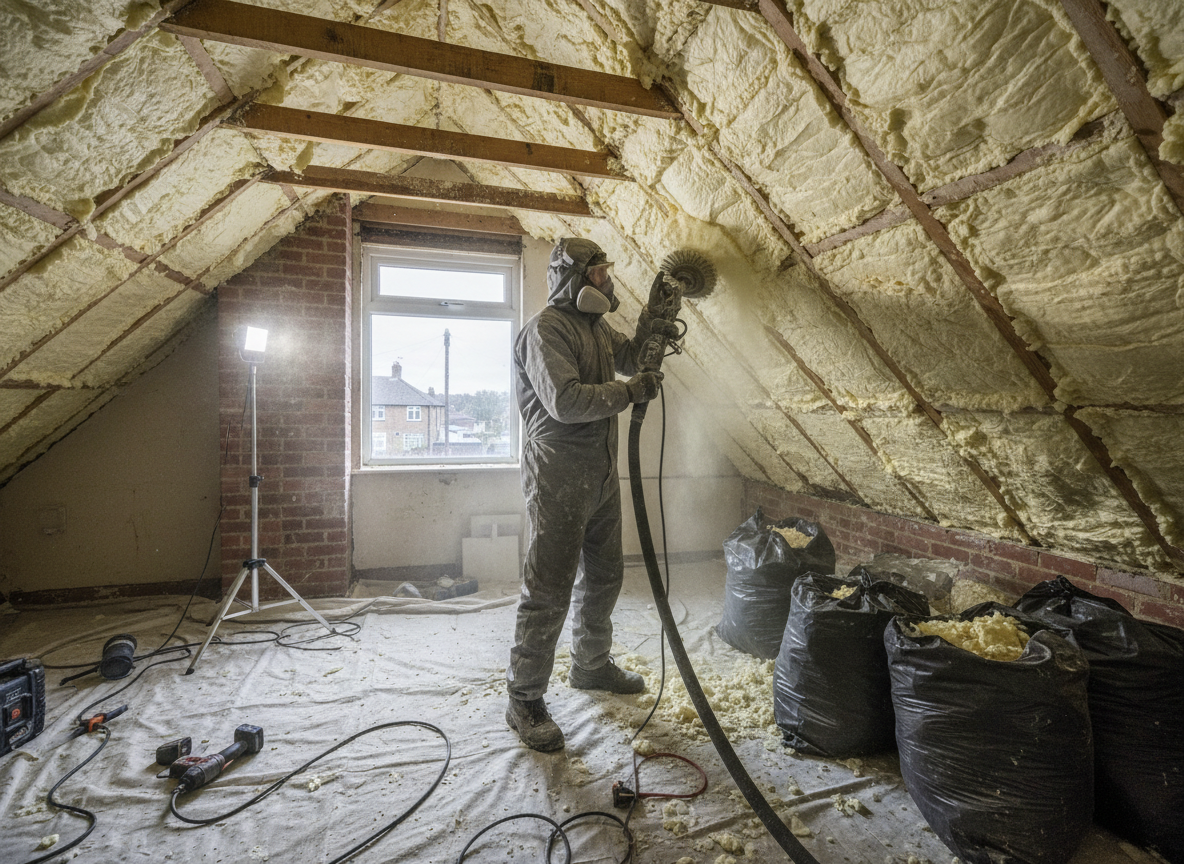
Grimsby housing stock includes many Victorian terraces and mid-century semis where closed-cell foam was blown into lofts decades ago to cut heating bills. Over time the material traps condensation from the Humber estuary air, leading to timber decay along rafters and joists. Removal crews must first cut ventilation slots through the foam to equalise pressure before mechanical extraction begins, otherwise sections can pull roof felt away from battens during pulling.
The process starts with a torch-and-probe inspection to map foam depth and any hidden electrical runs common in pre-1970s wiring. Crews lay heavy-duty polythene sheeting over ceilings and stairwells because loosened beads can drop through small gaps around loft hatches. Once removed, the waste is bagged on site and taken to licensed disposal points rather than left for household collection, which most local councils will not accept.
After extraction, rafters are checked for mould staining and treated where necessary before new insulation is discussed. Homeowners in the West Marsh and Nunsthorpe districts often request this service when selling, because surveyors now flag spray foam as a defect that blocks future mortgage lending on older properties.
Technician insight
In Grimsby, the thing that catches most people out with loft spray foam removal is how the damp air from the estuary makes the foam bond tighter to older rafters in terraces near the docks, so you often need extra time to avoid pulling felt off during extraction.
Foam Removal in a Freeman Street Terrace
Homeowner reported persistent loft damp after heavy winter rain. Inspection found closed-cell foam covering original mineral wool and blocking eaves vents. Crews cut ventilation channels first, then extracted the foam in sections to protect the roof lining. Once cleared, airflow improved and the owner avoided further timber issues.
How it works
- 1
Initial Loft Inspection
Technicians access the loft from Hainton Avenue base and assess foam type, depth, and any timber damage before quoting.
- 2
Site Protection and Containment
Floors, hatches and ceilings are covered to prevent foam particles falling into living spaces during removal.
- 3
Mechanical Extraction
Foam is cut into sections and removed using specialist tools, with ventilation restored to prevent future condensation.
- 4
Waste Removal and Cleanup
All material is bagged and taken away for proper disposal, followed by a final vacuum of the loft space.
Pricing
Cost depends on loft size, foam thickness and access difficulty in Grimsby properties.