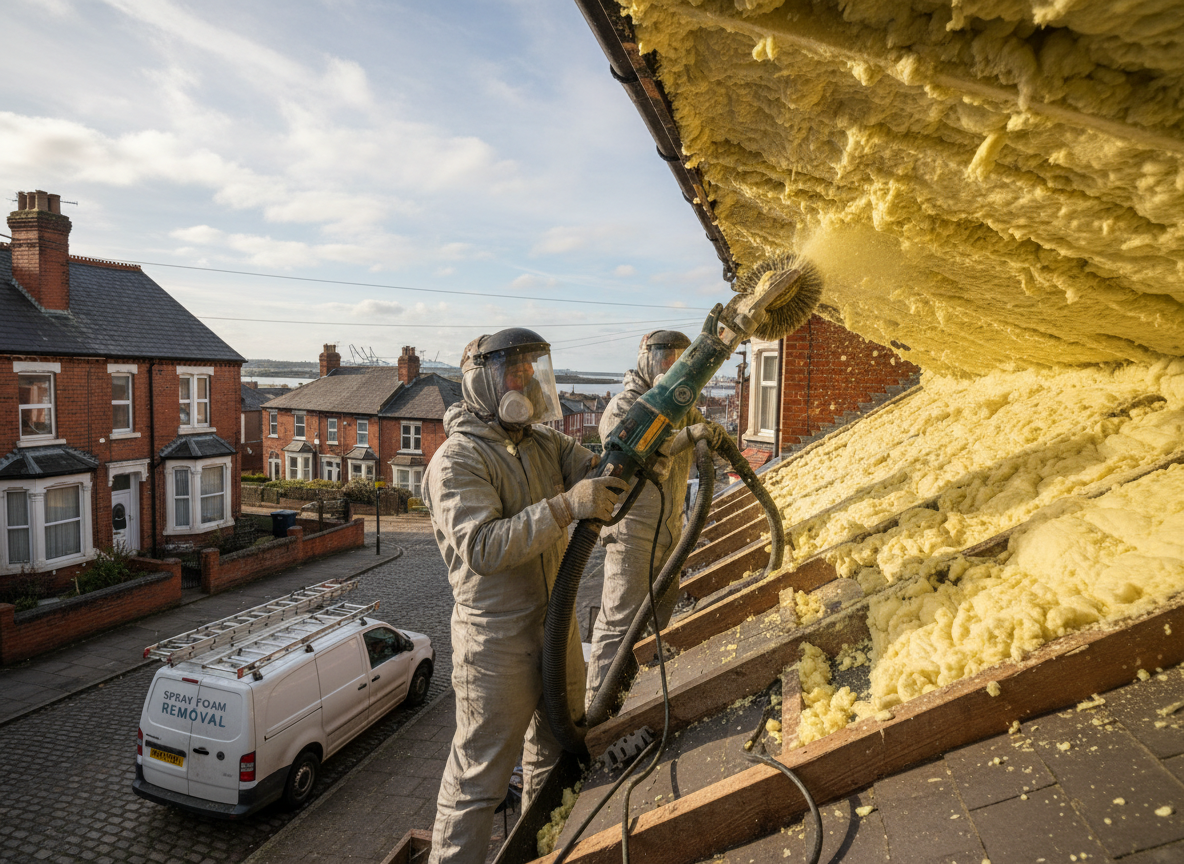
Grimsby homes built before the 1980s often contain closed-cell spray foam applied directly to roof decks and between rafters in terraced streets around Hainton Avenue and Nunsthorpe. Over time this material traps moisture against timber, leading to rot that only becomes visible once the foam is cut back. Removal crews must work from the loft downward while protecting original lath and plaster ceilings that remain common in these Victorian and Edwardian terraces.
Lincolnshire’s damp coastal air and frequent winter rainfall accelerate degradation of foam-to-timber bonds. Technicians therefore section the material into manageable blocks rather than pulling large sheets that can tear ceiling fixings. Dust and off-gassing during cutting require full containment with negative-air machines vented through existing chimney flues or roof vents to avoid affecting neighbouring properties in tightly packed rows.
Disposal follows Environment Agency rules for Grimsby-area waste; foam offcuts are double-bagged on site and taken to the approved transfer station on Estate Road rather than general landfill. Final inspection includes checking rafter ends for hidden moisture before any new insulation is considered, preventing repeat problems in the same roof voids.
Edge cases include foam that has been sprayed over electrical cables or into eaves shared with adjacent houses. These require careful tracing of wiring runs and temporary boarding to maintain separation between properties during extraction.
Technician insight
In Grimsby the thing that catches most people out with Spray Foam Removal near me is the older terraced stock around Hainton Avenue where foam bonds straight to lath and plaster that crumbles the moment you start cutting.
Nunsthorpe Terrace Loft
Homeowner noticed ceiling staining after heavy rain. Inspection showed closed-cell foam trapping moisture against rafters. Crew sectioned the foam, protected the original plasterwork below, and removed all material in one day. Timber was left dry and ventilated with no further staining reported.
How it works
- 1
Site Assessment
Survey loft access, foam depth, and any wiring or pipework in Grimsby properties before work begins.
- 2
Containment Setup
Install sheeting and negative pressure to protect living spaces and neighbouring homes in terraced streets.
- 3
Sectioned Removal
Cut foam into blocks for controlled extraction without damaging original ceilings or rafters.
- 4
Waste Disposal
Bag material on site and transport to approved Grimsby transfer station for compliant disposal.
- 5
Final Check
Inspect timber and ventilation before handing the loft back to the homeowner.
Pricing
Cost depends on loft size, foam thickness and access difficulty; upfront quotes given after inspection.